

![Item 243360. SEDER TEFILAH. THE ORDER OF PRAYER FOR DIVINE SERVICE: II. VOLUME: DAY OF ATONEMENT [VOL II ONLY, OF 2]](https://danwymanbooks.cdn.bibliopolis.com/pictures/42038.jpg?width=768&height=1000&fit=bounds&auto=webp&v=1668807296)
![Item 243360. SEDER TEFILAH. THE ORDER OF PRAYER FOR DIVINE SERVICE: II. VOLUME: DAY OF ATONEMENT [VOL II ONLY, OF 2]](https://danwymanbooks.cdn.bibliopolis.com/pictures/42038_2.jpg?auto=webp&v=1668807296)
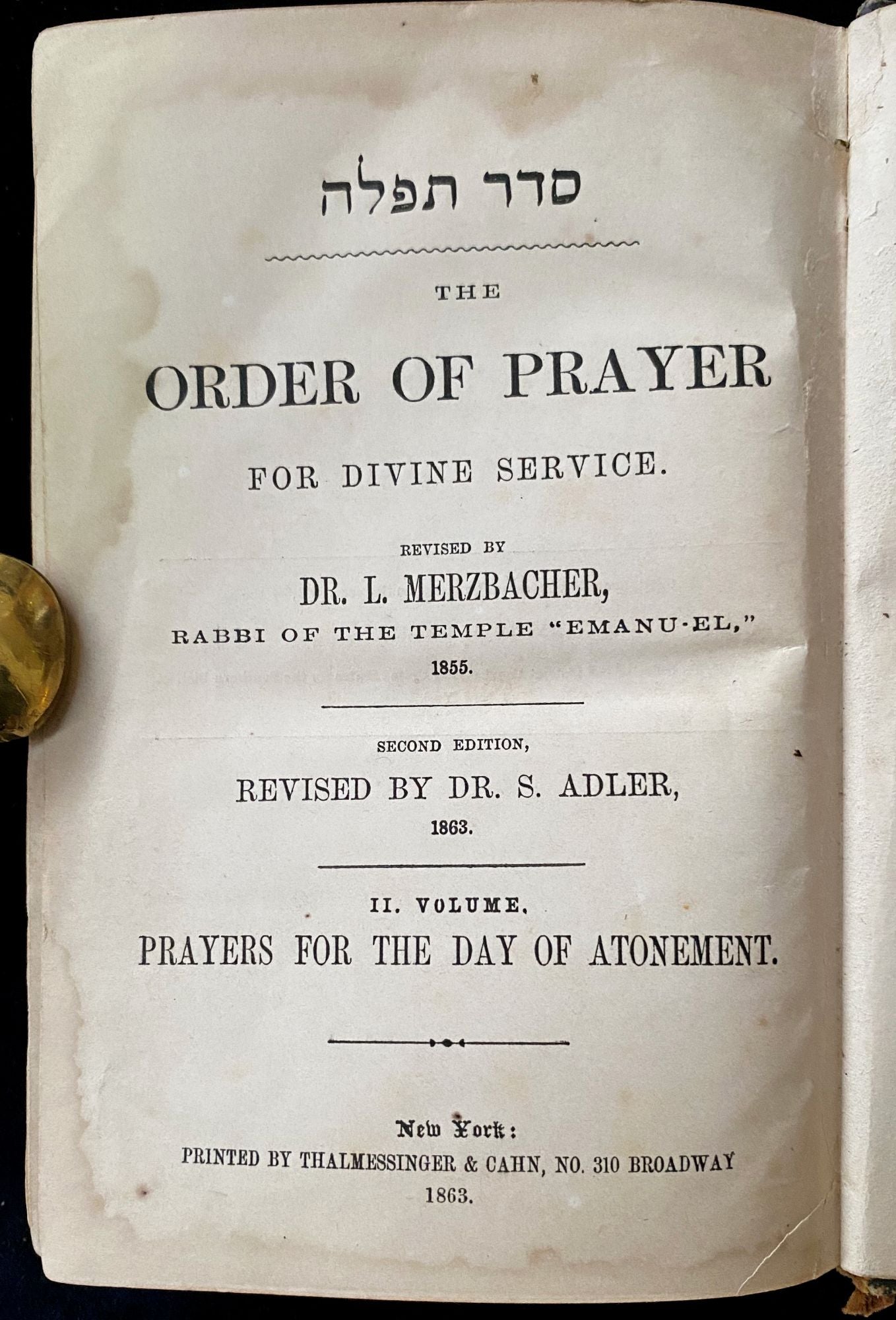
SEDER TEFILAH. THE ORDER OF PRAYER FOR DIVINE SERVICE: II. VOLUME: DAY OF ATONEMENT [VOL II ONLY, OF 2] סדר תפלה
New York, Printed by Thalmessinger & Cahn, 1863. Item #42038
2nd Revised Edition, edited, revised, and corrected by S. Adler, 1st printing thus. Original gilt tooled leather, 8vo, 396 pages. In Hebrew and English on facing pages. Formerly Singerman 1780, now merged into Singerman 1667 as vol II, variant 1 (Thalmessinger & Cahn).
The second of two volumes [vol. 1 Daily prayers & vol. 2. Prayers for the Day of Atonement, this volume ] substantially reworked by Adler and published 1860 (vol. I) and 1863 (vol. 2, here). Together these comprise the First Edition of Samuel Adler’s revised edition of Leo Merzbacher’s 1855 Prayer-Book.
Despite the modest title-page, Adler’s production here was not merely a revision, but rather an entire reworking with additions and alterations to the liturgy. Rabbi Leo Merzbacher’s original version of the prayers was quite traditional. “As resourceful and accomplished a liturgist as Merzbacher proved to be, he seldom sought to …willfully turn aside from the traditional cannon” (Friedland p. 36). Samuel Adler, on the other hand (Merzbacher’s successor at Temple Emanu-El of New York) had no such reservations about adopting radical change to the structure of the prayer-book. In his version of the “Order of Prayer” Adler did not rely on sources in Jewish tradition, rather he changed the prayers according to his subjective views of how synagogue services should be conducted. See Eric Lewis Friedland, (Brandeis University dissertation) The Historical and Theological Development of the non-Orthodox Prayerbooks in the United States, 1967.
Indeed it was precisely this 1860-1863 version of the “Order of Prayer” that was adopted by Temple Emanuel in New York, and all subsequent issues of the “Order of Prayer” utilized this version containing Samuel Adler’s revisions. The Union Prayerbook itself was largely based on Adler’s 1860-1863 revisions here.
Consequently, this prayer-book was also the cause of much controversy. Orthodox Rabbi Bernard Illowy of St. Louis fumed, that whomsoever utilized this “so-called” prayer-book was to be “entirely excluded from all religious communion” (see Michael A. Meyer, Response to Modernity: A History of the Reform Movement (1995) p. 237).
Leo Merzbacher (1809-1856) received his Rabbinic ordination from the celebrated Rabbi Moses Sofer of Pressburg (the “Chasam Sofer”), the leading opponent of the Reform movement. Merzbacher immigrated to America in the 1840’s “and was the first Reform rabbi in the country. After serving at Anshe Chesed and Rodeph Sholom in New York, Merzbacher became the rabbi of Emanu-El, the first Reform temple in the city….[The 1855 edition of] This prayer book was the first Reform edition issued in America for general use” (Goldman). Merzbacher adopted changes in synagogue custom such as the prominent use of an organ and eradicating the observance of the second day of festivals. Samuel Adler (1809-1891) replaced Merzbacher in Temple Emanuel in 1857, following the latter's death, where he served until 1891. Adler’s son, Felix, was the founder of the Ethical Culture movement.
SUBJECT(S): Siddurim -- Texts. Reform Judaism -- Liturgy -- Yom Kippur -- Siddour -- Textes. Judai¨sme re´forme´ -- Liturgie -- Yom Kippour -- OCLC: 78354364. Lacks top 1 inch of backstrip (spine covering) and rear blank endpaper; wear to boards, some stains, but solid good condition. Rare and Important (AMR-69-11-B-D).
Price: $1,000.00